Stop 04 · Baroque
4. Saint Benedict’s Chapel
Sculptors Santacruz and Sala · Painters Savall, Layga and Grau · 1675–1735
One of the finest examples of the monastery's Catalan Baroque.
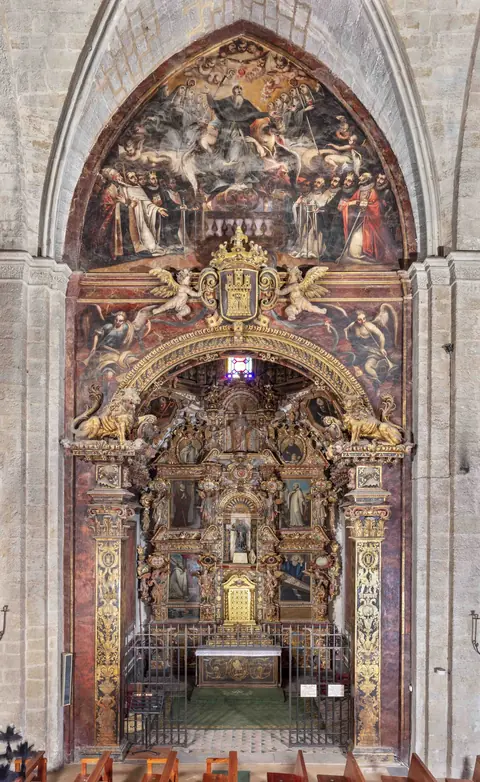
You are in the Chapel of Saint Benedict of Nursia. It is one of the finest examples of Catalan Baroque and the most richly decorated chapel in the monastery.
This chapel was conceived as a living, organic, and all-encompassing space. The altarpiece, the walls, and the dome form a single unified whole, with hardly a corner left undecorated. This abundance of detail is no accident: —it is meant to express the richness and fruitfulness of Saint Benedict’s life.
Now direct your gaze to the centre of the altarpiece. Inside the niche, you will see the figure of Saint Benedict, the central figure of this chapel. You may be surprised by how small the sculpture is. And indeed, the original statue was much larger, but it disappeared in 1936 and was replaced by the one you see today.
Saint Benedict lived between the fifth and sixth century and was the founder of the Benedictine Order. For almost a thousand years, a community of Benedictine monks lived here, in the monastery you are now visiting. That is why he is the most frequently represented saint throughout this church, with more than twenty paintings and sculptures dedicated to him.
His Rule — with its famous motto ora et labora,“pray and work” — had an enormous influence not only on religious life, but also on society as a whole.
This chapel seeks to make visible the lasting legacy of Saint Benedict across the centuries.
The saint stands at the centre of an expanding wave of goodness that reaches far beyond his own lifetime.
Benedict was like a tiny mustard seed that grew into a vast tree, filled with fruit.
This idea is reflected throughout the entire altarpiece. If you look closely, you will find fourteen large angels: eight of them carry candles, symbolising the light Benedict brought into the world; while six others play stringed musical instruments, in praise of his work.
Surrounding Saint Benedict are images of five important saints of the Benedictine Order, founders of major religious congregations. Among them are Saint William; Saint Robert of Molesme — founder of the Cistercian Order — and Saint Romuald, founder of the Camaldolese Order. You will even find Pope Saint Celestine V, famous for resigning from the papacy — an unusual decision in his time.
Among the decorative elements of the altarpiece, you may also notice the coats of arms of various military Orders, whose rules were inspired by the Benedictine Rule. This is yet another sign of how Saint Benedict’s influence extended into civil society as well.
And now, lift your eyes towards the dome. At its centre you can see the Holy Spirit in the form of a dove. Around it is a circle of eight Benedictine nuns, a reminder that this spiritual path was also lived by many women throughout the centuries. The rest of the dome is filled with paintings of popes and Benedictine saints who played an important role in the life of the Church.
Take a moment to immerse yourself in this space. Notice how everything here seems to revolve around a single idea: a life that, through simplicity and faithfulness, bore abundant fruit and left a profound mark on history.